
Language has always been a foundational pillar of civilisation. Homer’s Iliad and Odyssey shaped Greek identity, ethics, politics, and education for centuries, giving the ancient Greeks a shared cultural inheritance despite their division into independent city-states. Throughout the epics, Homer contrasts truthful and deceptive speech, emphasising the moral weight of language. Odysseus is celebrated for his eloquence and cunning, yet his words are ultimately judged by whether they restore justice, order, and social harmony.
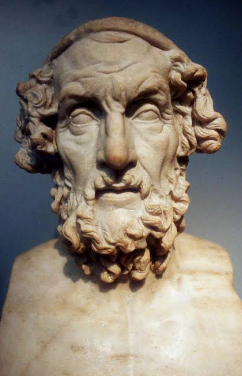
The modern epics may be understood through two prominent realist traditions: classical realism, commonly associated with Hans Morgenthau, and structural realism, associated here with John Mearsheimer. Both recognise recurring patterns of conflict, competition, and power politics. They differ primarily in where they locate their source.
Mearsheimer argues that the principal driving force is the anarchic international system, in which no higher authority can guarantee the security of states. In this self-help world, states must prioritise survival and accumulate power. Although leaders retain agency, the incentives created by anarchy push states towards similar behaviour because survival remains their overriding objective.

Morgenthau, by contrast, argues that political judgement is rooted in relatively constant features of human nature. His proposition that “politics is governed by objective laws rooted in human nature” reflects the belief that politics exhibits regularities not only because of the international system, but also because human characteristics remain sufficiently stable across time. Ambition, fear, prudence, honour, morality, and judgement therefore remain central to political outcomes.
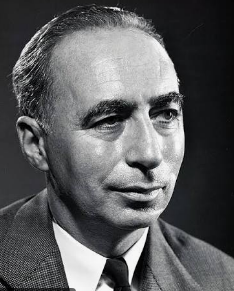
Both acknowledge that leaders make choices and that outcomes are not mechanically predetermined. Morgenthau, however, assigns greater explanatory weight to individual judgement, recognising that ideology, personality, nationalism, religion, moral conviction, and prudence can substantially influence decisions. Mearsheimer argues that rational leaders facing similar structural conditions should generally reach similar conclusions. Departures are more commonly explained by miscalculation, imperfect information, or poor judgement than by enduring differences in character or ideology.
It is perhaps telling that many international-relations scholars subscribe to structural realism, while ordinary observers may find classical realism equally compelling. One reason may be that scholars are expected to rely upon publicly substantiated evidence, whereas ordinary people are often more willing to form judgements about motives and intentions that cannot be directly observed. Academic analysis generally assumes that institutions operate substantially as documented unless corruption or covert action can be demonstrated. Because concealed intentions are, by their nature, difficult to observe and verify, scholars are understandably reluctant to build theories upon them.
As a result, academic explanations often favour structural causes, while outcomes that others might attribute to deliberate human agency are more commonly interpreted as miscalculations, intelligence failures, bureaucratic incentives, or institutional dysfunction. This does not mean that covert agency is absent, nor does it imply that controversial claims are necessarily true. Rather, it reflects the practical limits of what can be demonstrated using publicly available evidence. Explanations that depend upon hidden intentions are inherently more difficult to verify and therefore less likely to become part of accepted academic theory.
The September 11 attacks provide a contentious example. Scholars such as Mearsheimer have little basis for constructing theories upon the unsubstantiated premise that neoconservatives or elements of the United States government were responsible. Members of the public who reject the official account may feel freer to assign greater weight to particular individuals. Similar disputes surround COVID-19: the mainstream account emphasises structural factors such as globalisation, population growth, and human encroachment upon natural environments, while critics seek greater scrutiny of individuals involved in funding or conducting gain-of-function and dual-use research. The point is not to resolve either controversy, but to distinguish explanations centred upon structural conditions from those centred upon agency.
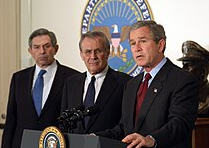
The same distinction appears in interpretations of Hamas’s Al-Aqsa Flood operation. The official Israeli explanation has centred upon intelligence and security failure. Others suspect a deliberate stand-down and argue that the devastation in Gaza reflects policy choices by the Netanyahu government rather than battlefield conditions alone. Again, the disagreement concerns how much weight should be assigned to systems, failures, intentions, and individual decisions.
A hybrid position accepts Mearsheimer's premise that the international system is anarchic and constrains the strategic options available to states, but rejects the reduction of agency to residual error or "foolish" decision-making. Leaders consistently act upon ideology, persuasion, institutional loyalties, and subjective interpretations of events. The international system sets the boundaries of action, but it does not determine the path taken within them. Political outcomes therefore remain inherently unpredictable because structural constraints are always filtered through human judgement. Morgenthau's appeal to a universal human nature is also incomplete. Although people share many common traits, they interpret the same objective environment in markedly different ways according to their beliefs, values, experiences, ideologies, and available information. Human nature may explain certain recurring tendencies, but it cannot fully account for the diversity of political judgement or the range of historical outcomes.
This conception resembles the Architect's worldview in The Matrix. The Architect designs a system governed by objective rules, yet discovers that its inhabitants cannot be predicted completely. Neo's significance lies not in escaping determinism, but in understanding how it flows through him. Like the exceptional figures of history and mythology, Neo demonstrates that while structure constrains the range of possible outcomes, extraordinary individuals can occasionally perceive and realise possibilities that the structure alone does not predict.
Neo represents a modern expression of the classical hero. Achilles is constrained by fate, yet distinguished by martial excellence and force of character. His choice of a short life in exchange for everlasting glory transforms an immutable constraint into the source of his immortality through language, memory, and myth. Odysseus confronts different structural forces. Faced with the seemingly impregnable walls of Troy and the countless obstacles delaying his return home, he prevails through ingenuity, prudence, and strategic judgement. Neo, Achilles, and Odysseus embody the same enduring theme: objective structures define the limits of action, but exceptional individuals determine how those limits are navigated and, at times, transformed.
This recurring archetype is striking because it stands in marked contrast to the emphasis of structural realism. Across mythology, epic literature, and popular culture, history is remembered through the actions of extraordinary individuals whose judgement, courage, and imagination alter the course of events. While modern scholarship often seeks explanations in systems and structures, the great narratives of civilisation consistently place exceptional human agency at the centre of history. The enduring tension between structure and agency is therefore not merely a philosophical problem; it is one of the oldest and most persistent motifs in humanity's faiths, myths, legends, and epics.
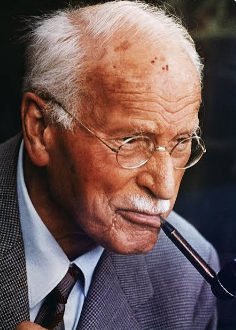
The Homeric institution of xenia, or sacred guest-friendship, was protected by Zeus Xenios. Xenia required hosts to welcome strangers before questioning them, provide food, drink, bathing, and shelter, and establish reciprocal bonds. Within The Odyssey, xenia serves as a measure of civilisation. Those who honour it demonstrate justice and restraint, while those who violate it are portrayed as morally corrupt. More broadly, it created trust in a fragmented world without central authority. Networks of hospitality facilitated diplomacy, trade, and alliances, sustaining order despite political anarchy. In modern terms, xenia was an institution that reduced uncertainty and encouraged cooperation.
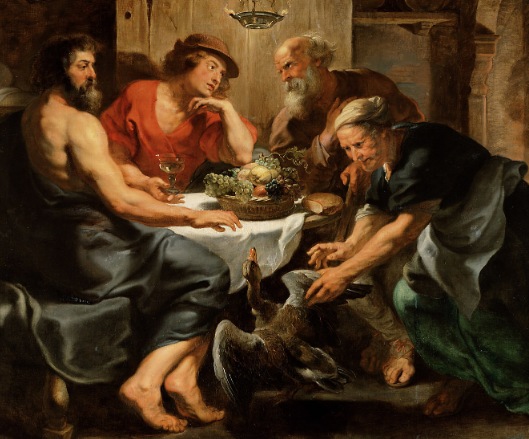
Since a stranger might be under Zeus’s protection—or even a god in disguise—hospitality was both a religious obligation and a practical necessity.
A comparable principle appears in Twelver Shi’a faith through the belief that the Hidden Imam may be encountered without being recognised. The comparison is structural rather than theological. In Homer, the possibility that a stranger may be a god reinforces xenia; in Twelver faith, the possibility that an unknown person may be the Hidden Imam encourages virtuous conduct. One acts rightly not because one knows who the stranger is, but because one does not. Uncertainty becomes a foundation for moral discipline and social trust.
Another enduring Islamic example is the account of the young Muhammad’s arbitration during the rebuilding of the Kaaba. When Mecca’s tribes disputed which clan should return the Black Stone to its place, the disagreement threatened violence. Muhammad proposed placing the stone upon a cloak, with a representative of each tribe holding one edge so that all shared in carrying it. He then placed it into position. The solution transformed a contest for honour into cooperation, preserving every tribe’s dignity. Like xenia, the episode illustrates that civilisation depends upon acts of judgement that cultivate trust, restrain hostility, and reconcile competing groups.
A similar theme appears in Christianity through compassion, mercy, and forgiveness. In the Gospels, Jesus teaches that social order cannot be sustained through retaliation alone, but requires individuals to restrain vengeance. Instructions to love one’s enemies, forgive those who trespass against us, and show compassion to strangers’ challenge cycles of reciprocal violence. The Good Samaritan extends moral obligation beyond family, tribe, and ethnicity, making compassion towards the stranger a defining feature of righteous conduct.
Across these traditions, a broader pattern emerges. Homeric xenia encouraged hospitality towards strangers. Islamic traditions emphasised virtuous conduct towards the unknown and reconciliation among rivals. Christianity extended compassion, mercy, and forgiveness towards enemies. Each addresses a different relationship—strangers, rivals, or enemies—yet all express the same civilisational principle: societies depend not merely upon power and formal institutions, but upon moral norms that cultivate trust, restrain hostility, and interrupt cycles of violence. These virtues function as social technologies that make political order and civilisational flourishing possible.
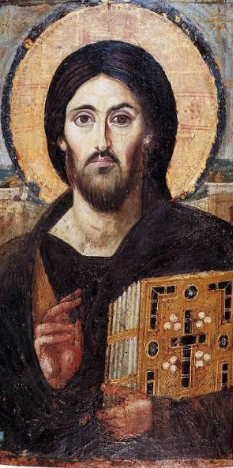
These universal civilisational ethics are also reflected in the Arthurian tale of Perceval, particularly in its themes of compassion and moral discernment. The young Perceval initially believes that success lies in imitating the outward behaviour of knights. He follows rules without understanding their purpose and is therefore naïve rather than wise. Having been advised not to ask too many questions, he remains silent during the Grail procession. His silence conforms to convention but fails the wounded Fisher King, who requires compassion and inquiry. Customs, the story suggests, exist to promote human flourishing, not to replace moral responsibility.
Perceval's failure lies in allowing convention to suppress compassion. Faced with a visibly wounded king, he remains silent because he believes it is improper to ask questions. His eventual maturity comes when he understands that customs exist to serve human beings, not the reverse.
Steven Spielberg's Ready Player One draws upon this tradition through its protagonist, Parzival. He wins the first key not by driving faster than everyone else, but by discovering that he must first go backwards in order to move forwards. Like his medieval namesake, Parzival must first return intellectually and morally, questioning the assumptions that have guided his actions before he can truly progress. His setbacks are not interruptions to the journey but essential stages of it. The same pattern lies at the heart of the Christian understanding of repentance and forgiveness: genuine transformation begins by turning back, recognising error, and only then moving forward.

In summary, language has always been a foundational pillar of civilisation. For the ancient Greeks, a shared language preserved a common inheritance of stories, concepts, and moral ideals, allowing otherwise divided communities to recognise themselves as participants in a wider cultural world. Language did more than communicate experience: it gave societies the means to interpret experience, transmit ethical expectations, and imagine forms of conduct that transcended immediate self-interest.
Modern international-relations theory offers two prominent realist traditions through which the relationship between structure and human agency can be understood. Structural realism correctly recognises that the international system is objectively anarchic and therefore constrains the strategic options available to states. Yet these constraints are always interpreted through subjective human judgement. Structure therefore narrows the range of plausible outcomes, but it cannot determine which outcome will occur. Political decisions remain products of individual agency, shaped by character, perception, prudence, fear, and ambition.
Civilisation depends upon this space between structural constraint and human choice. Across otherwise distinct traditions, universal civilisational ethics repeatedly appear in the form of hospitality, compassion, forgiveness, restraint, and responsibility towards others. Xenia in the Homeric world, Muhammad's arbitration among the tribes of Mecca, Christian teachings on mercy and forgiveness, and Parzival's gradual moral awakening all express a related principle: inherited customs are valuable when they restrain hostility and promote human flourishing, but they must ultimately be animated by judgement and compassion. Rules alone cannot make a person wise, just as institutions alone cannot make a society civilised.
This is why the hero's ability to navigate the structural forces of his age remains such a recurring motif. The hero does not escape determinism; rather, he learns to understand how it flows through him and act wisely within it. Through failure, Parzival discovers that true wisdom lies not in blind obedience to convention but in recognising the deeper order of nature and the purpose of the structures that govern it.