
Long before Athens became the philosophical centre of the ancient world, the Aegean was already alive with ambitious centres of power. Mycenae, Pylos, Knossos and the great palace economies of the Bronze Age were bound together by ships and merchants, craftsmen and metals, ports and long-distance trading networks. The later Greek polis belonged to a different age, but inherited something important from the civilisation that preceded it: prosperity did not require a single centre doing everything. Different cities developed different strengths, competed, specialised and traded—and together created a civilisation far greater than the sum of its parts.
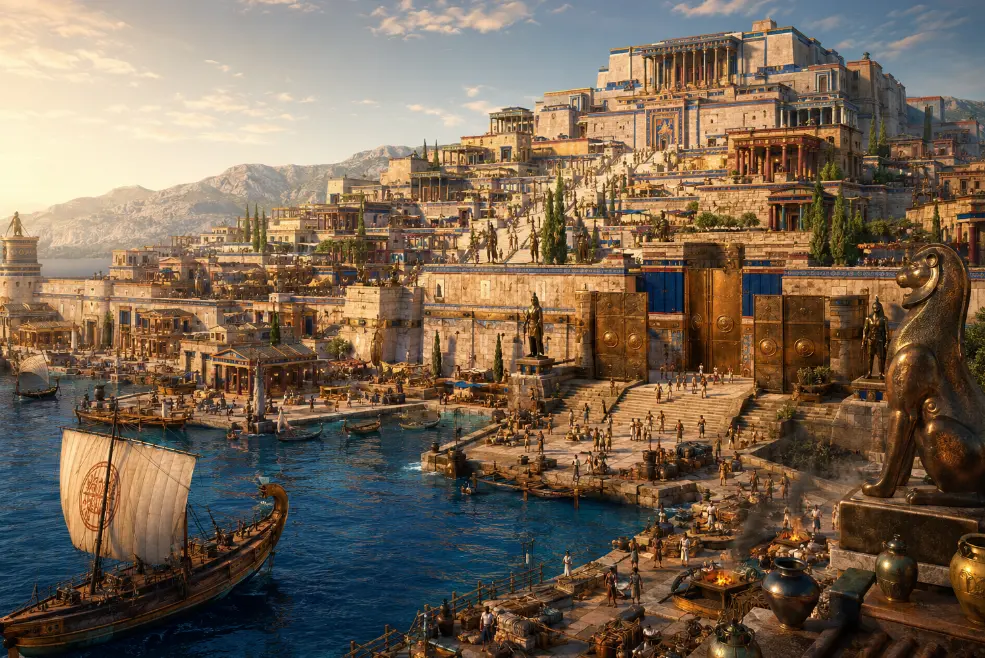
The Mycenaean palaces flourished roughly between 1600 and 1200 BC. Their world eventually disappeared, but the economic instinct behind it is strikingly modern: wealth was created by connecting resources, productive capacity and markets.
Australia might benefit from rediscovering something of that imagination.
For decades, Australian housing investment has encouraged us to think of the finished house as the investment. We buy the house, finance the house, rent the house, sell the house and debate endlessly about the price of the house. But perhaps the more interesting investment question lies one step further back:
What prevents the next house from being built?
Australia’s housing challenge calls for a broader vision of capital. Rather than concentrating investment in vehicles that ultimately compete for the homes already standing, more capital could flow into the productive foundations of housing itself—the skills, materials, industries, technologies and infrastructure that determine how many homes Australia is actually capable of building.
The great economies of the Bronze Age did not become powerful simply by accumulating gold and bronze. Behind every bronze sword stood a mine and a furnace; behind every palace, generations of craftsmen; behind every trading city, ships, harbours, warehouses and roads. The treasure was impressive, but the machinery that created the treasure was more important.
Australia could embrace the same philosophy.
Capital could target the bottlenecks constraining construction: advanced prefabrication and automation, domestic building-material production, skilled trades, engineering capacity, enabling infrastructure, serviced land and technologies that accelerate planning and construction. The ambition should extend beyond financing individual dwellings toward financing the productive machinery capable of building entire new communities—turning housing investment from a competition over scarcity into an engine for creating abundance.
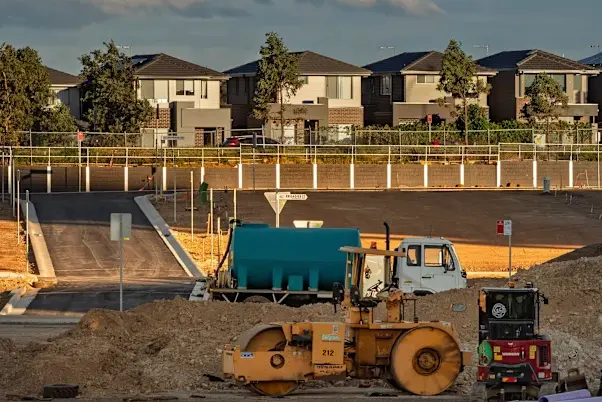
The object of investment becomes not simply the house, but the machine that produces houses.
Perth offers a magnificent stage upon which such ambition could be tested.
The great centres of the Bronze Age did not become legendary through timidity. They raised palaces and fortified cities, constructed harbours and sent ships beyond the horizon. They drew merchants, craftsmen, adventurers and wealth from across the known world. Their great monuments were not merely displays of prosperity; they were declarations that prosperous cities could attract still greater prosperity.
Australia could recover something of that spirit.
Under Donald Trump’s stewardship of the United States, why should Australia not court ambitious American investment—even something as conspicuous as a Trump resort rising beside Perth’s beautiful coastline or overlooking the Swan River? Such a development is entirely hypothetical, but that is precisely why it illustrates the larger point. Economic imagination begins by asking what could exist that does not exist today.
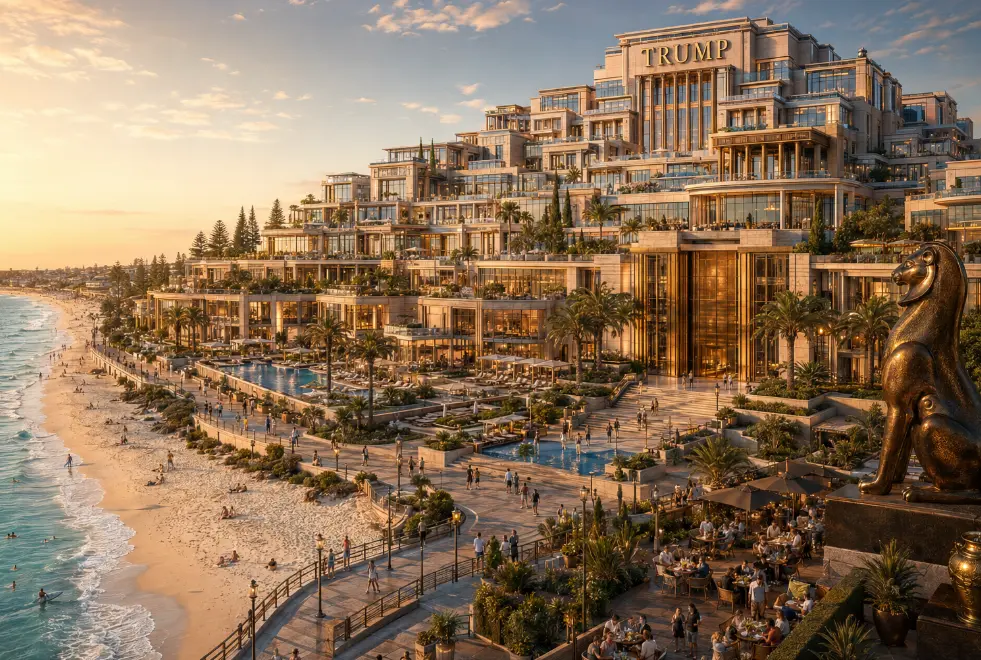
A globally recognised development could bring capital, tourism, enterprise and supporting infrastructure into Western Australia. But the ambition should extend beyond constructing another monument of glass and stone. Like the great cities of the ancient world, the objective should be to build the productive foundations around it: construction capability, transport, skilled employment, hospitality, infrastructure and surrounding housing supply.
A modern landmark could then become a catalyst for something much larger—not simply wealth arriving in Perth, but Perth acquiring greater capacity to create wealth of its own.
A great development should leave behind more than expensive real estate. It should enlarge the city that built it.
And the new harbours need not all be made of stone.
The same spirit of ambition can extend into the workshops and marketplaces of the digital age. Bronze Age prosperity accelerated when distant economic centres became connected through increasingly sophisticated networks of commerce and exchange. Today, digital infrastructure offers the possibility of connecting capital, assets and enterprise across the world almost instantaneously.
Australia should aspire to build a serious digital investment exchange capable of connecting international capital with Australian housing, infrastructure, commodities, energy, technology and tokenised real-world assets. The regulatory architecture is beginning to emerge: Australia’s new Digital Assets Framework brings digital-asset and tokenised-custody platforms into a regulated financial-services regime from April 2027.
The extraordinary emergence of $TRUMP demonstrates just how rapidly economic networks can now be assembled in this new world. Whatever one thinks of meme coins as an asset class, $TRUMP illustrates the ability of a globally recognised identity to create a digital asset and international marketplace with potentially enormous liquidity. Its official allocation states that CIC Digital LLC—an affiliate of the Trump Organization—and Fight Fight Fight LLC collectively hold 80% of the tokens, subject to an unlocking schedule, with total supply planned to expand from an initial 200 million tokens toward one billion over three years. Those releases represent substantial potential future supply, although their eventual consequences for market liquidity and value will depend upon how unlocked holdings are ultimately used.
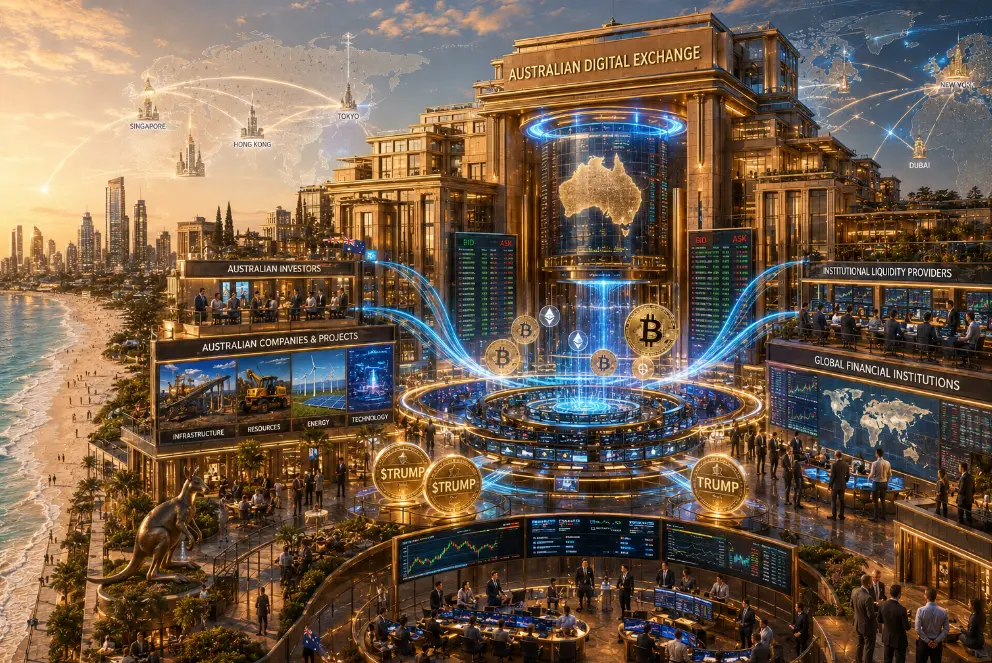
The larger lesson for Australia is not about meme-coin speculation. It is that the architecture through which capital is created, exchanged and mobilised is changing.
Perth could aspire to become one of the marketplaces of that emerging economy: a regulated digital exchange where conventional and digital capital meet productive Australian projects. If bronze once travelled between Cyprus, Mycenae and the great commercial centres of the eastern Mediterranean, the assets and commodities of a new Australian age could move through digital markets spanning Perth, Singapore, Dubai, Tokyo and New York.
And then there is energy—the furnace beneath the city.
Western Australia occupies a remarkable geographic position. It faces the Indian Ocean and the petroleum-producing states of the Persian Gulf while standing at Australia’s western gateway to the great economies of Asia. Yet Australia retains only two major operating oil refineries, at Geelong and Lytton, which together supplied around 20% of Australia’s fuel requirements in 2025.
Why, then, should Perth or northern Western Australia not contemplate something more audacious: not simply another refinery, but a new generation of advanced energy complex capable of competing with the great industrial centres of Asia?
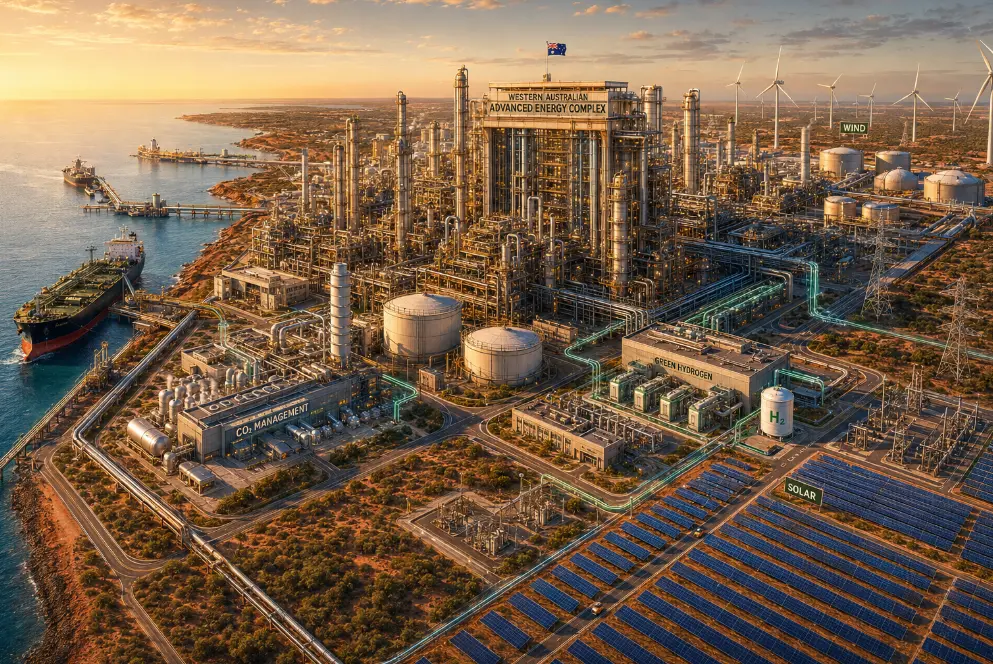
At its heart could sit technologically advanced crude-oil refining, surrounded by the infrastructure of a changing energy system—large-scale solar and wind generation, green hydrogen, energy storage and sophisticated CO₂ capture, transportation, utilisation and geological-storage systems. Rather than treating petroleum and emerging energy technologies as opposing industries, such a complex could integrate them, using Western Australia’s extraordinary renewable-energy resources to reduce the emissions intensity of industrial processes while developing the engineering capabilities required for the energy systems of the future.
Such a project would still have to earn its existence economically. Scale, labour costs, crude supply, energy, logistics and Asian competition cannot be conquered by grandeur alone. But if the economics could be made to work, its strategic value could extend far beyond the refinery gate. It could anchor petroleum trading, fuel storage, shipping, petrochemicals, specialised fuels, renewable electricity, hydrogen, carbon management, engineering and international investment within a single industrial ecosystem.
Most importantly, it could strengthen Australia’s supply-chain security. Greater domestic refining and strategic storage capacity would reduce exposure to disruptions at foreign refineries, congested shipping routes and geopolitical crises in the Middle East and Asia. An integrated energy complex would therefore represent more than an investment in oil or renewables: it would be an investment in the resilience of the entire Australian energy system—combining the fuels Australia still requires today with the technologies it may increasingly depend upon tomorrow.
And here the story returns to where it began.
The Bronze Age was not mighty because bronze existed. It was mighty because civilisation learned to connect the mine to the furnace, the furnace to the craftsman, the craftsman to the ship, the ship to the marketplace—and the marketplace to the city.
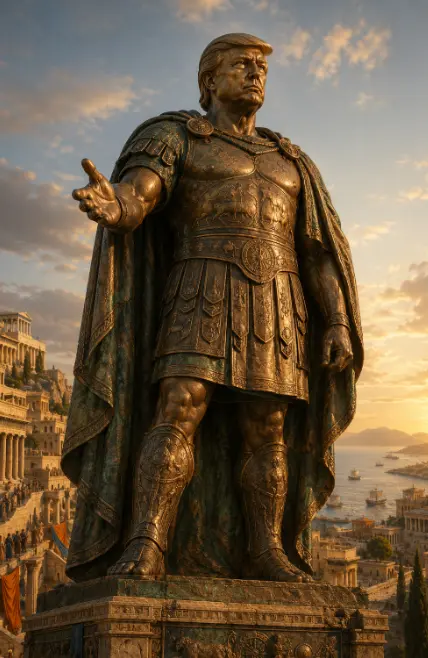
Our furnaces, ships and marketplaces may look different now. They are construction systems and refineries, ports and data centres, digital exchanges and global capital networks. But the principle remains remarkably similar.
Civilisations do not become wealthy merely by accumulating valuable things. They become wealthy by creating the systems capable of making new things possible.
Australia already possesses extraordinary resources, educated people, political stability, sophisticated institutions and cities positioned on the doorstep of Asia. Perhaps what it needs now is a little more of the audacity that once built palaces on the hills of Mycenae and sent ships beyond the edge of the known world.
The next Australian economic story could be less about bidding ever greater sums for what already exists—and more about building the mines, furnaces, workshops, harbours and marketplaces of a new age.