The United States, Israel and Iran are staring each other down, their positions hardening with seemingly little room for compromise. Yet in the background, a more uncomfortable calculation is taking place: the doctrine built around anti-ballistic missile defence is increasingly being called into question.
On one side, Zelensky continues to plead for more Patriot interceptors; on the other, experts such as MIT Professor Theodore Postol have spent decades questioning the effectiveness of these systems.
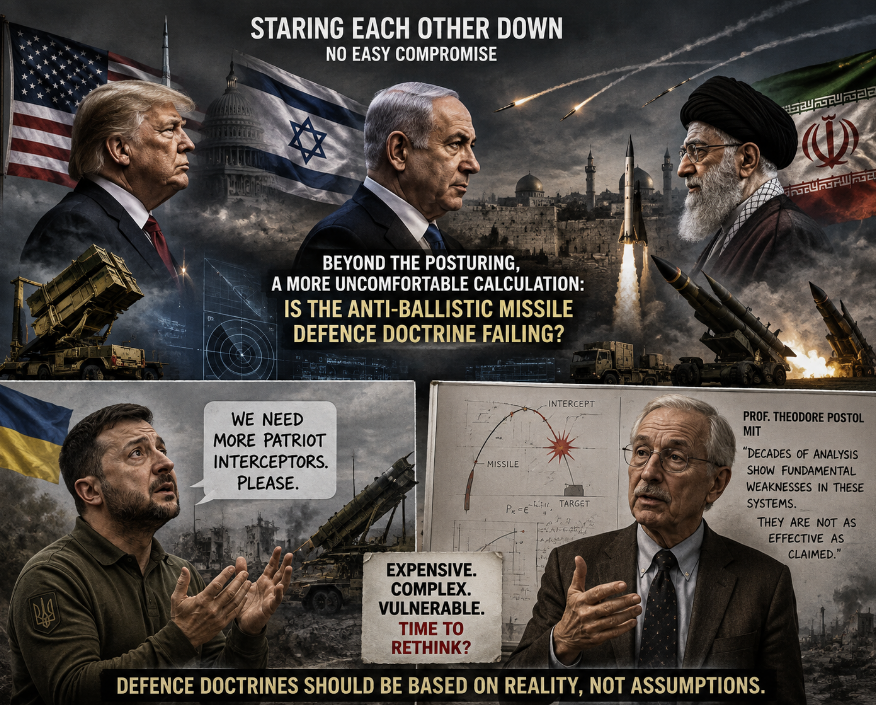
And all of this is unfolding against an increasingly political clock: U.S. midterms in November, Israeli elections in October, and a Trump administration framing Iran sanctions in stark “with us or against us” terms.
To understand how we got here, it is helpful to look back at history and take a high-level overview. After WWII, Zionist advocacy increasingly shifted from the British Empire to the United States. Many Jewish Zionists had roots in Eastern Europe and were associated with left-leaning liberal politics.
Vietnam became one of the major battlefields of the Cold War, both militarily and politically within the United States. A defining feature of the Vietnam era was the growth of the anti-war and peace movements, particularly on university campuses. Some Jewish liberal academics became disillusioned with the anti-war movement and increasingly believed that U.S. military power could be used abroad for what they considered legitimate or moral purposes—to “go abroad in search of monsters to destroy.” This outlook aligned with both anti-communist interventionism and strong U.S. support for Israel.
Neoconservative ideology gained momentum during the Nixon and Ford administrations and helped shape the tougher, more assertive foreign policy of the Reagan era. This approach continued into the George H. W. Bush administration, which oversaw the collapse of the Soviet Union and the end of the Cold War.
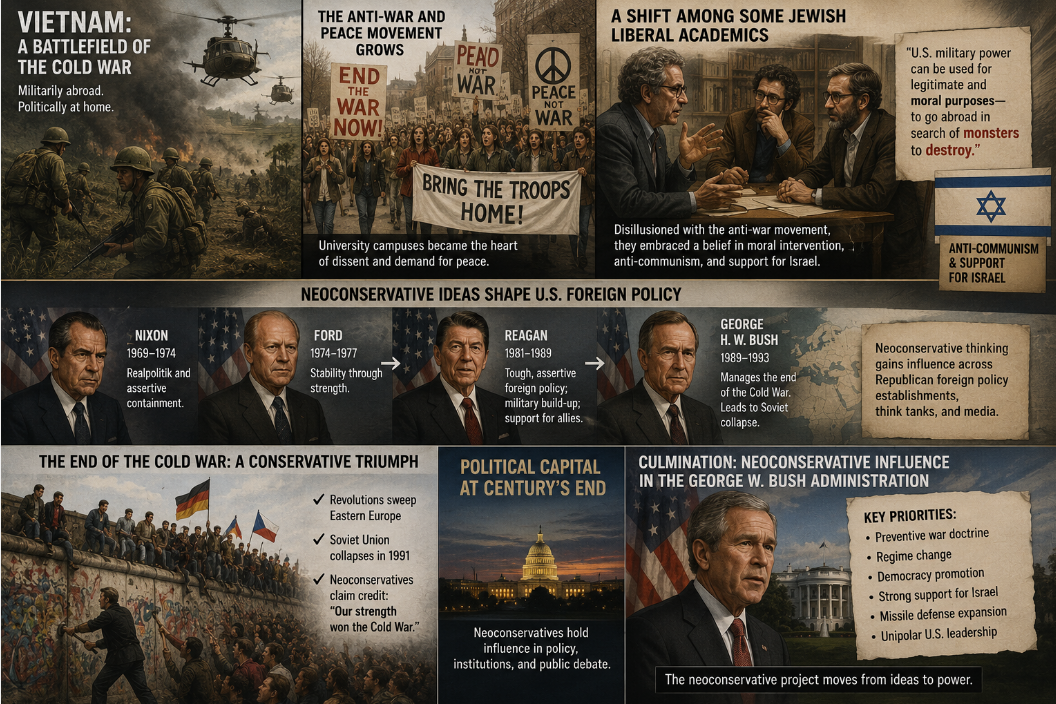
For many conservatives, this assertive foreign policy was a major factor in winning the Cold War, with the revolutions across Eastern Europe seen as decisive. This interpretation gave neoconservatives significant political capital by the end of the century, culminating in substantial neoconservative influence within the George W. Bush administration.
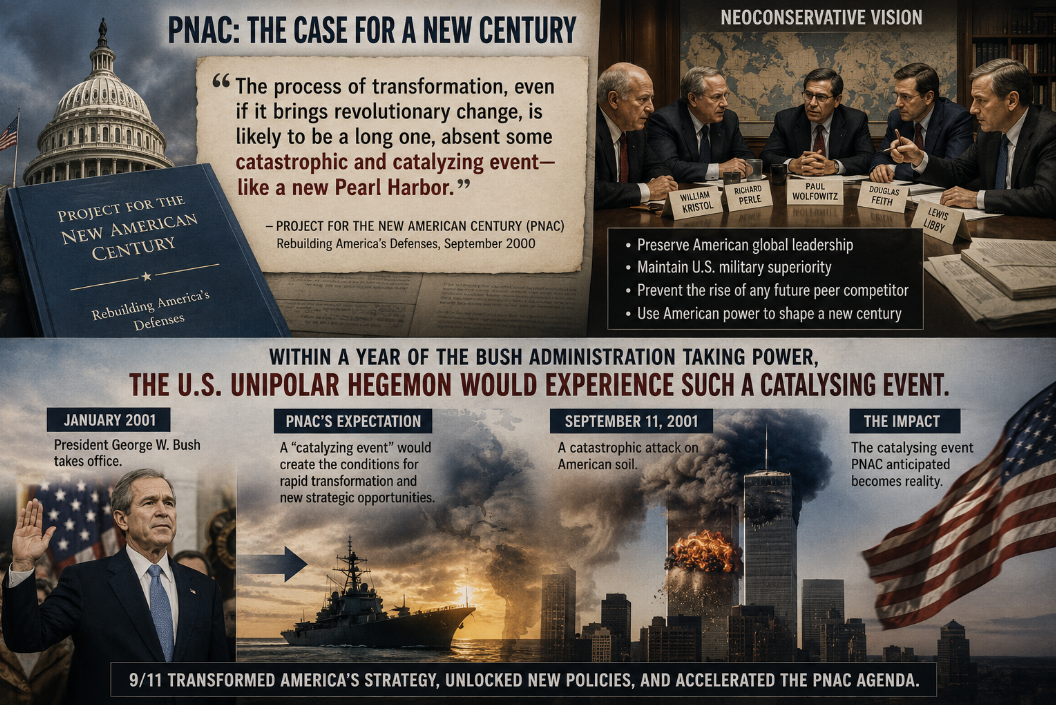
With the new century beginning, a major political and military doctrine advanced by neoconservatives and Bush administration figures was embodied in the Project for the New American Century (PNAC). A core PNAC argument was that the end of the Cold War risked slowing the transformation of the U.S. military and the development of new technologies, with ballistic missile defence forming an important part of this agenda.
Famously, PNAC argued that “the process of transformation, even if it brings revolutionary change, is likely to be a long one, absent some catastrophic and catalyzing event—like a new Pearl Harbor.” Within a year of the Bush administration taking power, the U.S. unipolar hegemon would experience such a catalysing event.
The shift soon became concrete policy. In December 2001, President Bush announced U.S. withdrawal from the 1972 Anti-Ballistic Missile (ABM) Treaty, taking effect in June 2002 and removing major constraints on strategic missile-defence development.
The Bush administration then accelerated its layered Ballistic Missile Defense System (BMDS), prioritising Ground-based Midcourse Defense (GMD), Aegis/SM-3 and Patriot PAC-3, while advancing THAAD, space-based tracking and other technologies. In parallel, Israel—with substantial U.S. funding and cooperation—expanded its own layered missile-defence architecture, centred initially on the Arrow program.
It is difficult to overstate Israel’s reliance on its air and missile defence systems. With a relatively small population, Israel historically depended on maintaining a qualitative military edge over its neighbours, demonstrated in the 1967 and 1973 wars through superior air power, armour and training.
But as advanced technology became cheaper and more accessible, quantity increasingly became a quality of its own. Israel could neutralise an enemy air force; defending against large numbers of cheap drones, cruise missiles and ballistic missiles presents a fundamentally different problem.
This is at the heart of the uncomfortable calculation now confronting military planners in the Iran war. There is a real possibility that Iran—a country subjected to decades of severe sanctions—has exposed fundamental weaknesses in a force doctrine built around expensive, technologically sophisticated missile defences.
Israel appears to face several potentially existential strategic risks. Its international public support has sharply deteriorated, while the Mecca defence pact suggests a growing willingness among regional Islamic states to pursue collective security arrangements. Meanwhile, Iran has achieved a degree of credible nuclear ambiguity.
In Israel’s favour, Iran’s supply lines to Hezbollah have been significantly disrupted. Had those routes remained fully operational, Israel’s position could be considerably more precarious. However, Iraq—a critical link in the Iran–Hezbollah corridor—is politically fluid, including uncertainty over the remaining U.S. military presence. There is also growing friction between Türkiye and Israel over Syria, another critical part of the supply network.
A significant expansion of Iranian influence in Iraq, or changes in Turkish or Syrian policy toward Hezbollah, could therefore materially increase the threat to Israel. In a more extreme scenario, escalating Israeli–Turkish competition in Syria could encourage Syrian armed groups to adopt a Hezbollah-style asymmetric model against Israel.
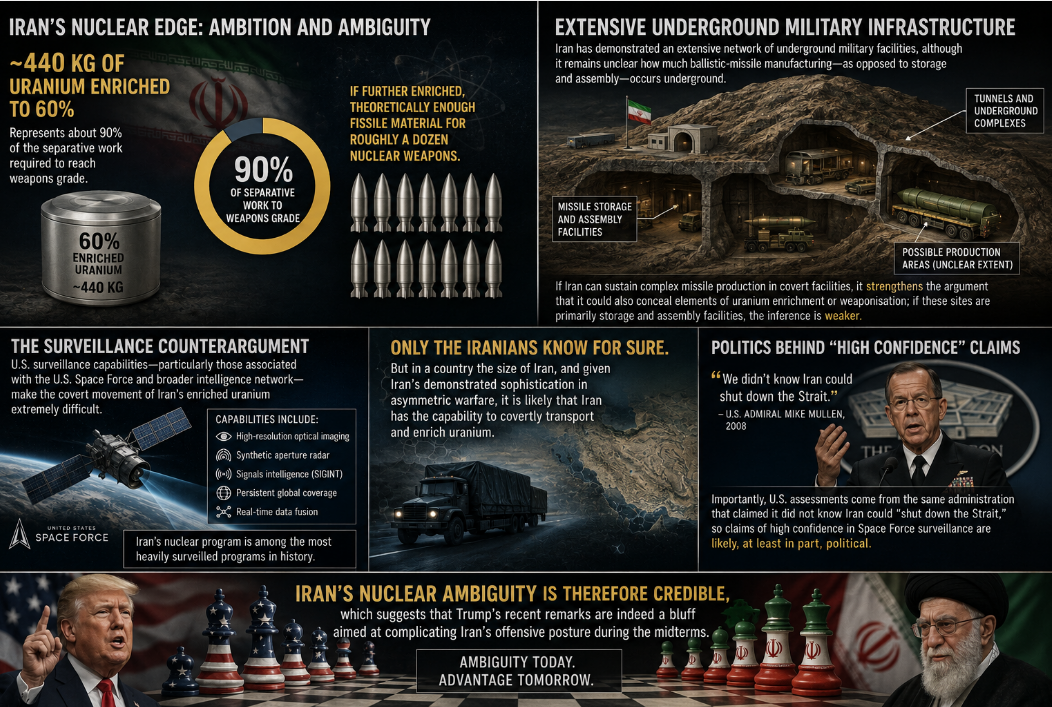
Meanwhile, Trump has signalled the possibility of using nuclear weapons against Iran, potentially as a bluff intended to encourage military de-escalation ahead of the midterms. Assessing whether it is a bluff requires an objective examination of Iran’s nuclear ambiguity and the strategic uncertainty surrounding its capabilities.
Iran is known to have accumulated roughly 440 kg of uranium enriched to 60%, representing about 90% of the separative work required to reach weapons grade and, if further enriched, theoretically enough fissile material for roughly a dozen nuclear weapons.
Iran has demonstrated an extensive network of underground military facilities, although it remains unclear how much ballistic-missile manufacturing—as opposed to storage and assembly—occurs underground. If Iran can sustain complex missile production in covert facilities, it strengthens the argument that it could also conceal elements of uranium enrichment or weaponisation; if these sites are primarily storage and assembly facilities, the inference is weaker. The counterargument is that U.S. surveillance capabilities, particularly those associated with the U.S. Space Force and broader intelligence network, make the covert movement of Iran’s enriched uranium extremely difficult.
Only the Iranians know for sure. The U.S. Space Force operates the world’s most sophisticated space-based surveillance systems, and Iran’s nuclear program is among the most heavily surveilled programs in history. But in a country the size of Iran, and given Iran’s demonstrated sophistication in asymmetric warfare, it is likely that Iran has the capability to covertly transport and enrich uranium.
Importantly, U.S. assessments come from the same administration that claimed it did not know Iran could “shut down the Strait,” so claims of high confidence in Space Force surveillance are likely, at least in part, political. Iran’s nuclear ambiguity is therefore credible, which suggests that Trump’s recent remarks are indeed a bluff aimed at complicating Iran’s offensive posture during the midterms.
In summary, the neoconservatives were strong advocates of a forward, offensive U.S. foreign policy. These policies were highly influential in key Eastern European political battlegrounds during the Cold War. Following the U.S. victory in the Cold War, neoconservatives gained significant political capital, which was subsequently exercised through the Bush administration, PNAC, the Middle East wars, and the development of key anti-ballistic missile technologies.
These technologies became central to Israel’s modern defence. However, the Iran war and the capabilities of paramilitary forces have called into question the reliability of these systems and the defence doctrines built around them. Israel now faces significant strategic risks: Iran has credible nuclear ambiguity, global public support for Israel has plummeted, and both the Trump and Netanyahu governments appear reluctant to compromise.
What is the lesson from all this? The tough, forward-leaning foreign policy pursued through the end of the Cold War and the unipolar moment has limitations. Likewise, the argument that U.S. investment in high-end weapons systems, such as the F-35 and integrated air-defence networks, is cost-competitive with ballistic missiles has its limits.
It may be more cost-effective for the United States to invest in F-35s than ballistic missiles, but that does not mean states such as Iran—or forces such as the Houthis in Yemen—cannot dominate the economics of exchange against the U.S. using cheaper, indigenously produced missiles and drones.
Whatever political capital Zionists gained from contributing to the defeat of the Soviet Union has been spent. The Netanyahu government, Israel, and its supporters will eventually have to account for the genocide in Gaza and the ethnic cleansing of Palestinians. From a broader humanitarian perspective, investment in weapons systems that sustain this forward, offensive posture is a drain on humanity. Nations would be better served by building sufficient trust to adopt more defensive postures and directing the resulting savings toward social welfare.
The goal of Israeli regional hegemony is analogous to the Soviet Union’s hegemony over Eastern Europe: both significantly went against the natural equilibrium. Just as Eastern Europe catalysed the downfall of the Soviet Union, the conflict with Iran will do the same to Israel’s regional hegemonic ambitions and U.S. global hegemony.
It is not clear whether the non-Jewish elements of the neoconservative movement were strongly ideologically aligned with Zionism, or whether some were simply pragmatic nationalists who believed that heavy investment in the intelligence and military-industrial complex was essential to U.S. power—in other words, keeping the Leviathan well fed and fat, so that America would have the biggest and scariest beast when the unipolar moment ended.
If the latter is the case, these elements within the intelligence–military-industrial complex should recognise that a nuclear Iran would likely strengthen the political case for larger defence and intelligence budgets.
The covert intelligence operations that propagate proxy wars need to end. Western governments do not have a political mandate to catalyse wars such as the one in Ukraine. Governments cannot initiate covert proxy wars around the world and then expect to conscript their citizens to fight foreign wars when those conflicts spiral out of control. Had governments been transparent about their covert activities in foreign countries from the outset, their citizens would never have voted to support those policies. It is a fraud on democracy and one of the gravest moral concerns.
At least Russia has a shared historical and cultural identity with Ukraine; the U.S., UK, France and others have no comparable connection, beyond killing Russians.
The Ukraine war carries potentially serious repercussions for Europe and NATO. While escalation to nuclear conflict remains unlikely, it is conceivable that a Russian-aligned buffer state could emerge from part of a rump Ukraine. What would NATO and Europe do if such a state turned the tables and Europe began facing hundreds of drones crossing its borders every week? Would European citizens accept conscription to stop them? Could NATO afford intercepting hundreds of cheap drones destroying it industrial factories?
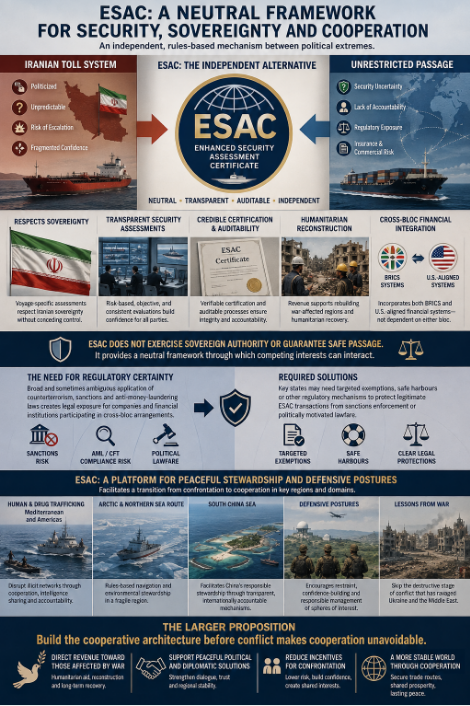
There is a creative off-ramp from the Iran conflict that could address immediate disputes while laying the groundwork for a broader cooperative security framework: the Enhanced Security Assessment Certificate (ESAC) system.
ESAC offers an independent, rules-based mechanism between the political extremes of an Iranian toll system and unrestricted passage. Iranian sovereignty could be respected while voyage-specific security assessments, transparent certification and auditable processes provide greater confidence to shipping, governments and commercial operators. Revenue could support humanitarian reconstruction in war-affected regions, while incorporating both BRICS and U.S.-aligned financial systems rather than depending on either bloc. Its independence is critical: ESAC would not exercise sovereign authority or guarantee safe passage, but provide a neutral framework through which competing interests could interact.
Implementation would also require regulatory certainty. The broad and sometimes ambiguous application of counterterrorism, sanctions and anti-money-laundering laws creates legal exposure for companies and financial institutions participating in cross-bloc arrangements. Key states may therefore need targeted exemptions, safe harbours or other regulatory mechanisms to protect legitimate ESAC transactions from sanctions enforcement or politically motivated lawfare.
More broadly, ESAC could facilitate a transition toward defensive force postures and responsible stewardship of spheres of interest. It could be adapted to human and drug trafficking in the Mediterranean and Americas, competing interests in the Arctic and Northern Sea Route, and eventually the South China Sea. Rather than waiting for confrontation to determine the regional order, an ESAC-style framework could help facilitate China’s responsible stewardship of the South China Sea through transparent, internationally accountable mechanisms—peacefully navigating the transition while skipping the unnecessary stage of conflict that has already ravaged Ukraine and the Middle East.
The larger proposition is to build the cooperative architecture before conflict makes cooperation unavoidable, directing revenue toward those affected by war while supporting peaceful political and diplomatic solutions.