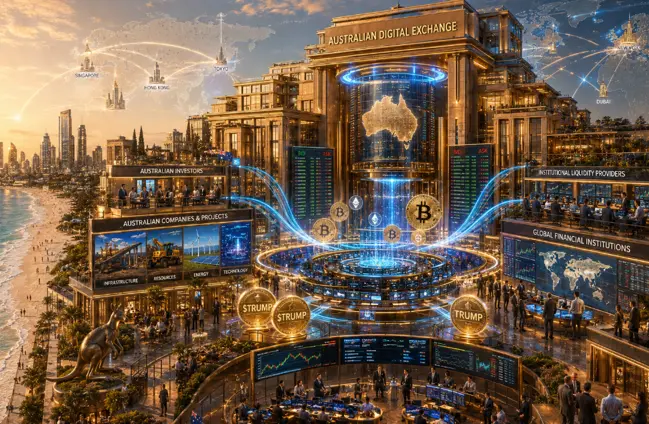
Before Trump can become a classical hero, he must identify the institutional walls that no longer serve their intended purpose—and be prepared to breach them in order to build something better. Consider the marine-insurance system operating through the Lloyd’s market. Shipowners pay substantial premiums while risks remain manageable, yet when insurance becomes most essential—during a major conflict or disruption—underwriters withdraw, exclude or price coverage beyond practical reach. A system that functions principally when the danger is limited, but retreats when the danger becomes acute, has surrendered much of its utility. It is precisely this kind of structural failure that demands a new model and classical hero.
Asia’s major economies are facing an increasingly urgent struggle to secure reliable supplies of oil and petroleum products, although China is better positioned than its regional peers to withstand the disruption. Its electrification revolution—driven by the rapid adoption of electric vehicles, electrified public transport and renewable power—has reduced petroleum dependence across important parts of its economy. China also holds substantial strategic and commercial oil reserves capable of cushioning a temporary supply shock.

Nevertheless, the Strait of Hormuz remains Asia’s principal energy artery. In 2025, almost 15 million barrels of crude oil per day—approximately 34 per cent of global seaborne crude trade—passed through the Strait, predominantly bound for Asian markets. China and India received 44 per cent of these exports, while the more petroleum-dependent economies of Japan and South Korea remain particularly exposed.
The continuing disruption therefore threatens far more than fuel prices. It affects aviation, petrochemical production, manufacturing, freight and food supply chains across Asia, while increasing electricity costs in economies that remain dependent on oil and gas generation.
This leaves President Donald Trump with a rapidly closing window to reach at least an initial arrangement with Iran—one capable of reopening the Strait and providing a foundation for broader negotiations. The United States midterm elections will be held on 3 November 2026, and as that date approaches, the political room for a difficult diplomatic compromise will shrink dramatically. Every additional week of disrupted trade and elevated energy prices strengthens Iran’s influence over the economic and political conditions in which the election will be fought.
If no negotiating framework is established soon, Iran’s options will also narrow. As the midterms approach, Tehran will have an increasingly powerful incentive to use its remaining leverage against Trump politically—allowing fuel prices, transport costs and economic uncertainty to erode public confidence in his management of the crisis. Iran does not need to defeat the United States militarily to inflict political damage. It need only keep the Strait disrupted long enough for the consequences to reach American households and become an electoral liability for Republicans.
The choice is therefore becoming stark. Trump can secure an opening agreement and present himself as the president who pulled the region back from war and restored the Gulf–Asia energy artery. Or he can enter the final months of the campaign with Iran’s hand tightening around global energy markets and the economic consequences being laid at his door. The negotiating window is not merely narrowing. It is approaching the point of closure.
An all-out Middle Eastern war would favour no one. It would endanger millions of lives, destroy infrastructure accumulated over generations and expose the global economy to an energy shock. Gulf production facilities, refineries, ports, pipelines and desalination plants would all become vulnerable. Iran would suffer immense destruction, but the Gulf states, Israel, Asian importers and the United States would also pay heavily. Even a military victory would leave behind damaged trade routes, displaced populations and an unstable regional order.
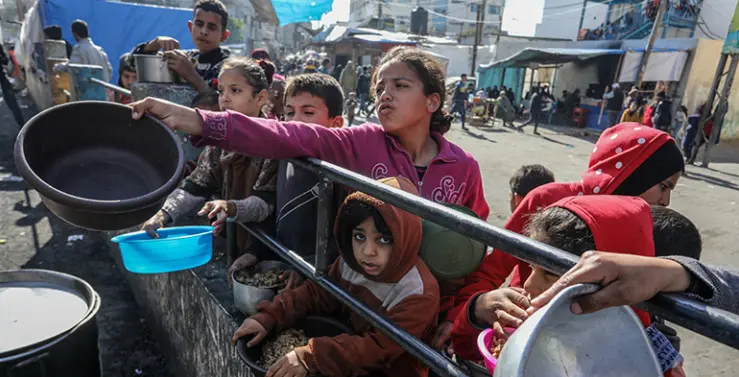
At the same time, Gaza’s humanitarian crisis continues. The United Nations reports that almost the entire population of approximately 2.1 million people has been displaced and that access to food, shelter and essential medical services remains inadequate. Although food-security conditions have reportedly improved in some respects, humanitarian coverage has declined and the danger of renewed deterioration remains substantial.
These crises should not be treated as entirely separate. A settlement reopening Hormuz could create the economic and diplomatic space for Asian governments and investors to support a new humanitarian initiative in Gaza. Countries benefiting from restored Gulf energy flows could allocate a small part of that economic dividend to reconstruction, medical services, food distribution and civilian payment infrastructure.
One possible element would be a carefully controlled digital payment system connected to Trump’s Gaza plan. This should not mean an unregulated cryptocurrency experiment. It could instead involve a transparent, auditable digital asset or tokenized payment mechanism through which approved donors fund verified humanitarian transactions. Properly designed, the system could record transfers, restrict the purposes for which funds are spent and provide visibility from the original contributor to the final merchant or aid provider.
Such a system would require dependable access to Asian digital-asset liquidity, cooperation from established market operators and strict compliance with sanctions, counter-terrorism-financing and anti-money-laundering rules. Independent audits, verified digital identities, transaction limits and controls preventing diversion to armed organizations would be essential. Digital infrastructure cannot compensate for the absence of food or physical access, but it could make legitimate humanitarian payments faster, more transparent and more difficult to misappropriate.
There is still time before the midterms to reopen the Strait and begin a limited trial in Gaza. A pilot could initially cover a defined population, geographic area and group of approved suppliers. It could be tested alongside conventional aid rather than immediately replacing it. Success would be measured through delivery reliability, transaction costs, civilian access, fraud prevention and the proportion of funds reaching their intended recipients.
Only Trump presently possesses the combination of American executive authority, political influence over Israel and direct negotiating capacity necessary to drive both components forward. Other governments can apply pressure or offer assistance, but Washington remains uniquely capable of persuading—or compelling—Prime Minister Benjamin Netanyahu’s government to withdraw Israeli forces sufficiently to permit a protected humanitarian and payments system to operate.
For this reason, Trump should consider parking the final Iran nuclear settlement without abandoning monitoring or containment. Iran’s nuclear infrastructure has likely suffered a substantial setback, providing time for verification, intelligence collection and later negotiations. Attempting to resolve every nuclear, sanctions, compensation and regional-security dispute simultaneously may prevent agreement on the immediate priorities: reopening Hormuz, preventing escalation and relieving Gaza.
The approaching election creates a practical order of operations. First, secure maritime de-escalation and restore energy traffic. Second, obtain an Israeli withdrawal from agreed areas of Gaza and establish protected humanitarian access. Third, test a transparent payment architecture. Asia-Pacific digital-currency actors are willing to participate, provided they receive reliable access to suitable liquidity providers in major markets such as the United States. The broader nuclear settlement could then resume under conditions of reduced economic urgency and military pressure.
A Democratic-controlled Congress would be able to frustrate important parts of Trump’s domestic and foreign-policy agenda after the midterms. Reducing fuel pressure and demonstrating a diplomatic breakthrough would therefore serve both an international purpose and Trump’s own political interests. This is not an argument for ignoring nuclear proliferation; it is an argument for sequencing negotiations according to urgency.
Following an agreed Israeli withdrawal, an international peacekeeping or monitoring mission would be considered. Personnel from Asian and Indo-Pacific countries—including Indonesia, Australia, Japan and China—could contribute under an accepted international mandate. A broadly based Asian mission would carry advantages. Indonesia could contribute credibility within the Muslim world; Australia and Japan could provide logistics, engineering, medicine and administration; and China could bring resources and political weight. Working together on civilian security, aid delivery and payment infrastructure could build practical trust among important regional powers that otherwise approach one another cautiously.
This would be more than a humanitarian program. It could become a demonstration that Asian powers can cooperate around energy security, peacekeeping and accountable financial technology without requiring complete strategic alignment.
Trump has long presented himself as someone capable of breaking through institutional barriers that constrain conventional political leaders. Here is an opportunity to test that claim. Reopening Hormuz, preventing a regional war, extracting Gaza from permanent military crisis and establishing an accountable humanitarian-payment system would constitute a more consequential achievement than another temporary ceasefire.
The “Bronze Age renaissance” associated with Trump’s political mythology should ultimately mean more than monuments, strength and national grandeur. In the classical tradition, the hero is remembered not only for overcoming enemies but for restoring order after violence. If Trump can use American wisdom to reopen the world’s most important energy passage, force the IDF out of Gaza and create the conditions for humanitarian reconstruction, he could transform that symbolism into a durable legacy.
The window remains open—but it is closing.